From 1,600 applicants to the shortlisted 250. Three young Nigerians who had never entered a hackathon before. Ten days of sleepless nights. Six Squad API integrations. One platform built for 90 million invisible workers. Here is everything that happened.
I got the email on a regular Tuesday afternoon. I almost didn't open it. But the subject line stopped me cold — "You're In. Your Team Has Been Shortlisted for Squad Hackathon 3.0."
I read it three times. Then I called my teammate. Then I read it again.
Out of over 1,600 applications from university students and young builders across Nigeria, Team SmartFlow had made it into the shortlisted 250. We were going to Lagos. We were going to compete. And none of us — not a single one of us — had ever entered a hackathon before.
The Challenge — And Why It Hit Different
Squad Hackathon 3.0's theme was "Smart Systems: The Intelligent Economy." We had two challenges to choose from. We chose Challenge 2 — design an intelligent economic system that connects informal traders, job seekers, and financial services in one ecosystem.
The reason it hit different is because I have seen this problem my entire life. I grew up watching people work hard every single day — market traders, artisans, delivery riders, food vendors — people who move real money, build real businesses, and provide real value. But when they walk into a bank and ask for a loan, the bank says:
"You have no financial history. We cannot help you."
Not because these people aren't creditworthy. But because nobody built the infrastructure to see them. Their work is real. Their income is real. But it leaves no digital trace. And without a trace, they are invisible to the formal financial system.
That is the problem we decided to solve. We called our platform OjaPass. Oja — the Yoruba word for market. Pass — your passport into the formal economy.
What We Built
I won't pretend the scope wasn't intimidating. When we sat down and mapped out everything the brief was asking for — financial onboarding, AI matching, credit scoring, digital savings, loan infrastructure — it looked impossible in two weeks. But we had done hard things before. Tutorial Haven, LagSciPrep, Inventrii — I have always believed the best way to see if something is possible is to start building it.
So we started building.
-
💳
Squad Virtual Accounts on registration — every user gets a real GTBank account number the moment they sign up. No branch visit. No paperwork. Under 60 seconds.
-
📊
OjaScore — a Bayesian credit scoring engine (0–100) — built from real transaction data, sales records, gig completions, Ajo contributions, and client reviews. Not a made-up number. Math applied to real behaviour.
-
🏪
Mamatally — a full business management layer — inventory tracking, sales recording, digital storefront, payroll, stock movement ledger. Turning everyday hustle into structured business data.
-
🔒
Gig Marketplace with Escrow — employers post gigs, AI matches them with the best seekers, escrow is funded via Squad before work begins, Squad Transfer API releases payment on completion. Zero risk for both parties.
-
🤝
Digital Ajo Rotating Savings — digitizing the centuries-old Nigerian communal savings system. Fully automated. Squad-powered. Contribution consistency feeds the OjaScore.
-
🏦
Loan Engine with real amortisation logic — loan offers automatically generated when a user crosses a score threshold. Sized to 1.5x their average monthly turnover. Disbursed via Squad Transfer API into their virtual account.
-
🧠
Gemini AI matchmaking and score narratives — AI that ranks gig applicants by skills, location, and OjaScore, and translates credit score changes into plain English coaching for every user.
-
💼
Seeker Portfolio with verified client reviews — gig workers post their work history, share a unique UUID token link with past clients, and build a verified digital reputation that no one can fake.
Six Squad API integrations in total. Virtual Accounts, Payment Links, Transfer API, Webhook listener, Verify endpoint, and Payout transfer for loan disbursement. Squad wasn't a feature we bolted on at the end. It was the backbone the entire platform was built around.
The Nights
I won't sugarcoat it. There were nights I genuinely did not sleep. Debugging Django views at 2am. Chasing Squad sandbox errors at 3am. Rewriting the OjaScore engine from scratch on day 9 because I realised the original approach had a fundamental flaw — it was letting volume game the quality calculation.
There was one night where the Squad sandbox just went down completely. Every payment call was timing out. I sat there refreshing their status page, running pings, trying every URL variant in their docs. Nothing. At some point I just laughed, added a mock fallback, and went to sleep. The sandbox was back by morning.
That is hackathon life. You build around the blockers. You don't wait for perfect conditions. You ship.
The Day — May 15 & 16, Lagos
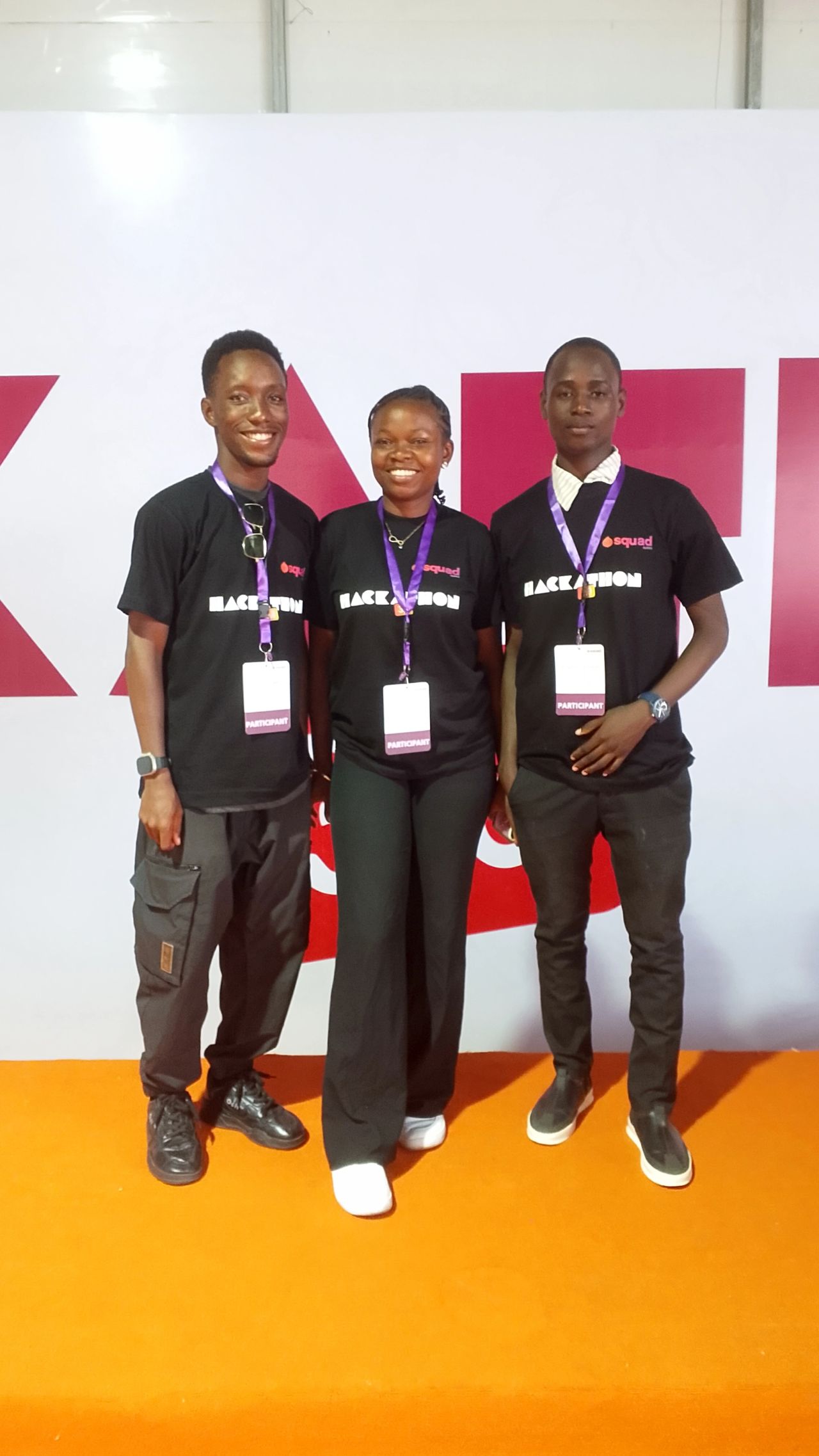
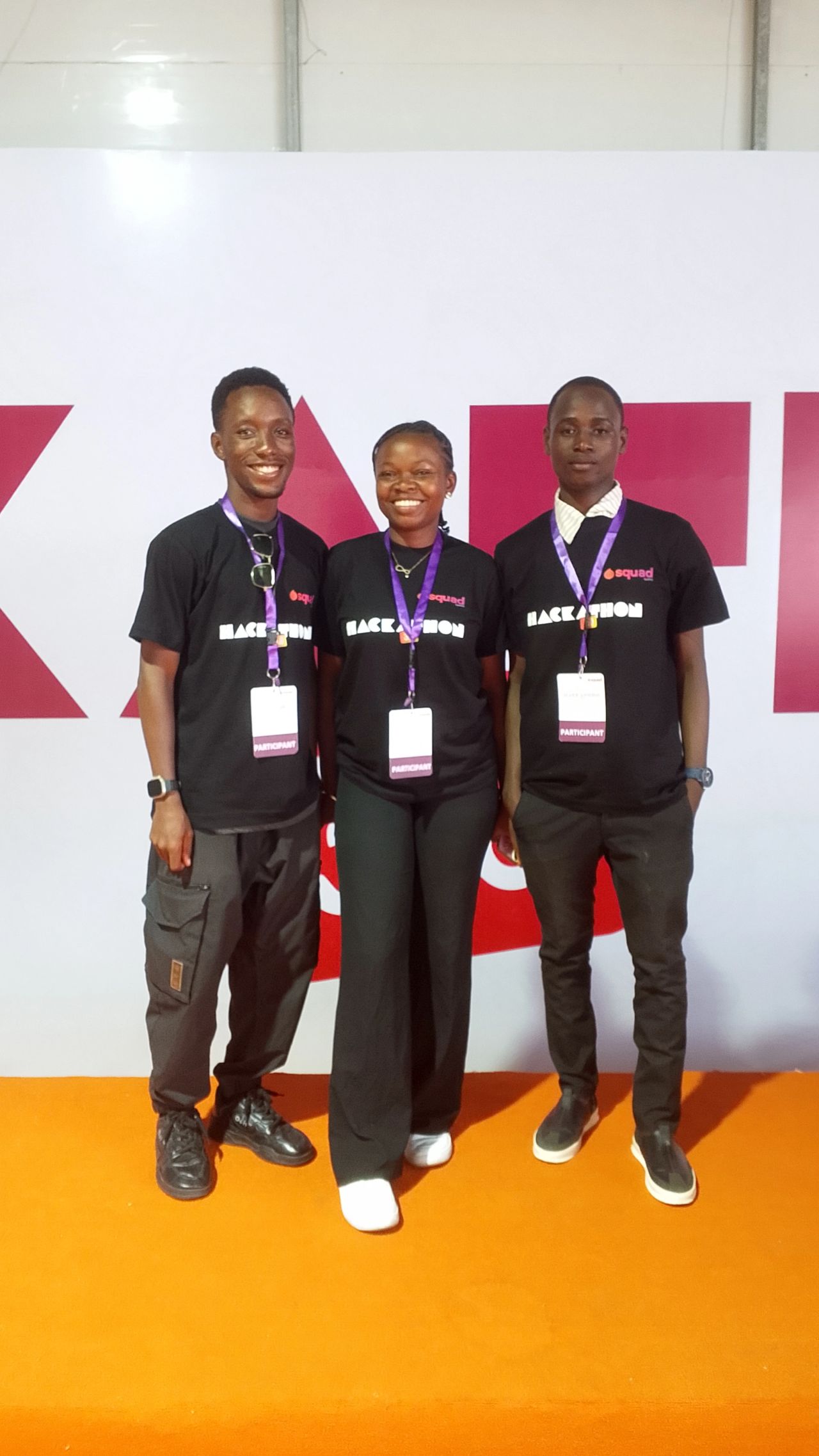
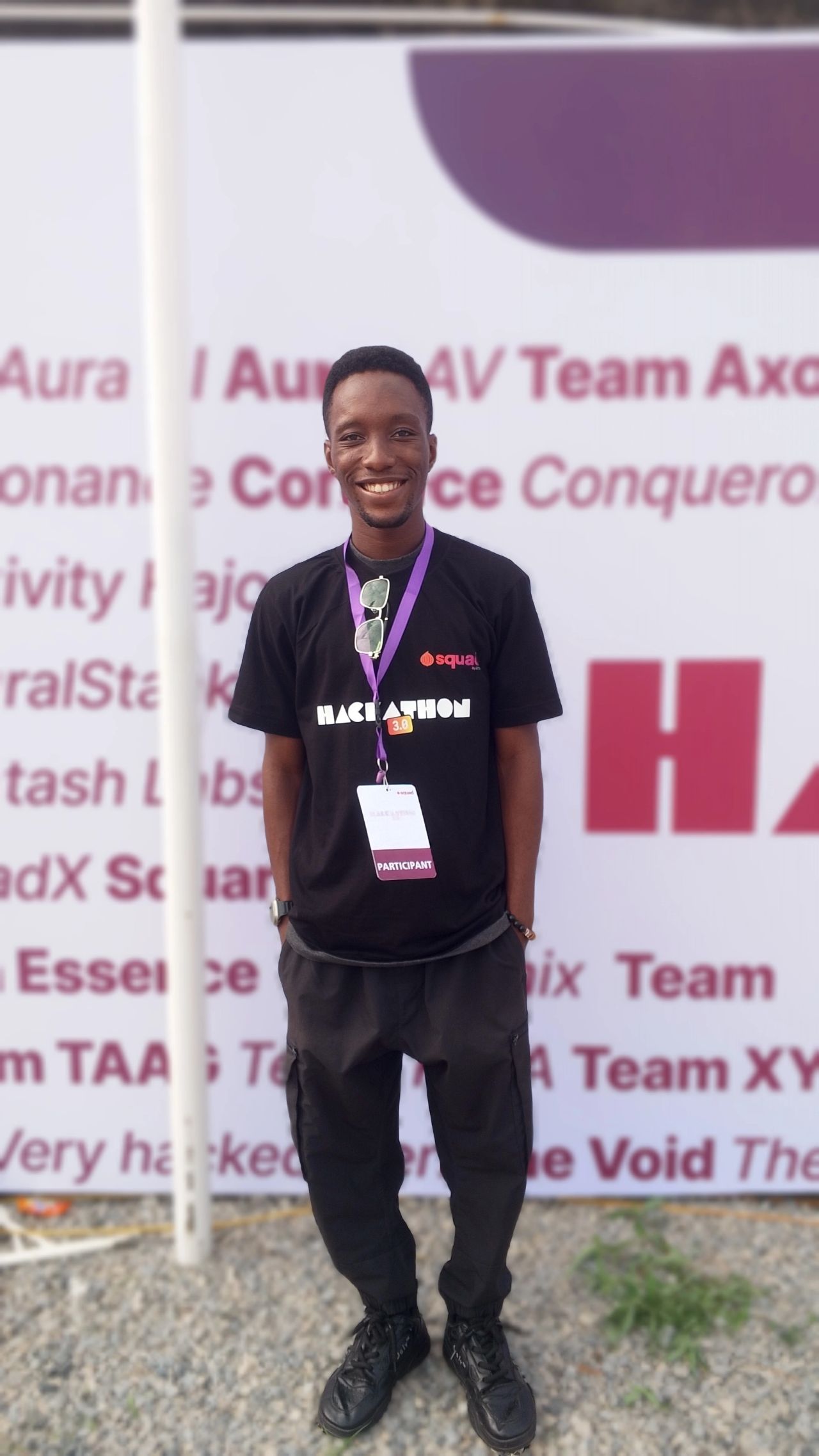
Walking into the venue was surreal. Teams everywhere. Laptops open. Energy that you could feel in the air. This was real. This was happening.
We set up. We did our final demo run. We talked through our scripts. Serah, David, and I each knew exactly what we were going to say and when. We had rehearsed the five-minute demo so many times that I could have done it in my sleep.
The speech by Mr. Segun Ajibade stopped me completely. It was simple. No jargon. No corporate fluff. Just the truth about what it means to build in Nigeria, why it matters, and what the responsibility looks like when you have the ability to build things people need. I wrote nothing down but I have not forgotten a word of it.
"You don't have to be in government offices to shape the economy. You can shape it right from behind your PC."
We presented. We ranked 77th. We did not make the semifinals.
On Not Making the Semifinals
I want to be honest about this. There was a sting. We had built something real. We had put everything into it. And we wanted to stand in that room and show it to the world.
But here is what I know now that I didn't fully know before: the point was never the ranking. The point was what happens inside you when you commit fully to building something that matters, on a deadline, under pressure, for people who actually need it.
Ranking 77th out of 1,600 applicants — for first-timers — is not a failure. It is a foundation. We now know exactly what we are capable of. We now know how to build under pressure. We now know that the informal economy problem is real, solvable, and worth dedicating serious work to.
OjaPass is not going in a drawer. It is going into production.
What I Learned — For Any First-Time Hackathon Builder
The judges don't care about 10 features that half work. They care about one complete story — user does X, system does Y, something meaningful happens. Nail that loop first. Every other feature is secondary.
Most teams integrate Squad as the last 10% — a payment button on a checkout page. We built the entire platform around Squad. Virtual accounts at registration. Webhooks driving the scoring engine. Transfer API for payouts. That's the difference between token integration and real integration.
How you explain what you built is as important as what you built. Judges are human beings. They respond to stories. Mama Shade in Oyingbo market trying to get a loan she deserves is more powerful than any architecture diagram. Lead with the human. Back it with the tech.
There is a version of me at 4am that makes terrible architectural decisions. I have met that version of myself. He is not good at his job. Protect at least 5 hours of sleep especially in the final two days. A rested builder is a better builder.
David brought design precision and clinical thinking. Serah brought HR depth and the ability to translate technology into human impact. I brought the engineering. None of us could have done this alone. The combination was the advantage.
Thank You, Squad
To the entire Squad and GTCO team behind Hackathon 3.0 — what you built here is more than a competition. It is an infrastructure for ignition. You took young builders who had ideas but no stage, and you gave them a real problem, real APIs, real judges, and real consequence. That is an incredible gift.
You didn't just give us an opportunity. You showed us that the path from a laptop in Lagos to changing how 90 million people interact with money is shorter than we thought. We just have to keep building.
And we will.
"We are not the team that built a demo. We are the team that will build the company."
In my next post I'll be sharing a full live demo of OjaPass — the platform, the Squad integrations, the scoring engine, all of it. Watch this space.
Want to see OjaPass in action?
A full live demo is coming soon. Follow me on Twitter for updates.
Follow @PrinceJetro123 View All Projects